
 With the Thanksgiving holiday just barely in our review mirror, and the Christmas season positioned squarely before us, most of us have visions of more than just sugarplums dancing in our heads! It’s a well-known fact that food is at the heart of every good holiday celebration, and it turns out that scientific research actually backs up the truth we already knew: the kitchen is the relationship hub, the heart of the home. While food has been said to be the way to a man’s heart, the kitchen is a space where communication, culture and connection are passed down to the next generation. So grab your toddlers and your preschoolers, don your best apron, and get ready for some quality time in the kitchen this holiday season!
What the Kitchen Teaches our Children
If you think back to your own childhood, you may have rich memories connected to cooking, baking and eating special foods with your family. We intuitively know that the kitchen is more than a place to make food, it’s a place to make memories and connections. It also functions as an incredible classroom, rich with language, culture, motor skills, and math and science lessons.
🍲 1. The kitchen is a language-rich environment
Did you know that children hear more back-and-forth conversations in the kitchen than in any other room of the house besides the bedroom? You may have noticed when you have company over, that people tend to gravitate to, and congregate in, the kitchen.
When kids help cook, they learn important age-appropriate cognitive and language skills like :
- new vocabulary (“stir,” “measure,” “soften”)
- sequencing (“first we wash, then we chop”)
- descriptive language (“smooth,” “crunchy,” “warm”)
These types of conversations are essential for early literacy development, which is at the core of early childhood education.
🍎 2. Meals strengthen emotional bonds
It’s no secret that family mealtime is linked to stronger parent-child attachment, better communication, and higher self-esteem in children. Preschoolers especially thrive in the routine of regular family mealtimes. Around the table, stories are shared, feelings are processed, traditions are passed down, and children feel seen and included. Additionally, when children are invited into meal prep, they experience similar benefits of attachment, cultural traditions and inclusion, boosting confidence and self-esteem.
✋ 3. Hands-on kitchen activities boost fine-motor skills
Inviting preschoolers to participate in meal prep is a fun and creative way to boost fine-motor skills. Cracking eggs, stirring batter, washing veggies activate the fine-motor muscles children will later use for writing. In fact, occupational therapists emphasize kitchen play because: 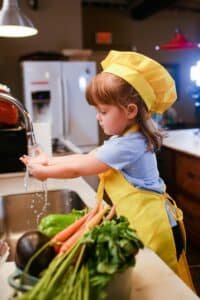
- it builds coordination
- it strengthens finger muscles
- it promotes bilateral hand use (using both hands at once)
This is why play kitchens are such a popular station in our preschool classrooms at Wishing Well!
🎓 4. Cooking introduces real-world math and science
Researchers argue that cooking is one of the most “naturally educational” activities young children can do. In the kitchen, preschoolers explore:
- Math: counting scoops, comparing sizes, measuring cups
- Science: melting, mixing, dissolving, heating, cooling
- Cause-and-effect: “What happens if we add too much water?”
The kitchen is a real-life, delicious, STEM lab!
Kitchen Play at Wishing Well
Wishing Well knows the value of the kitchen and corporate mealtimes! When your child enrolls at Wishing Well, they will have the opportunity to mimic the learning a real kitchen has to offer through pretend play. Research shows that imaginative kitchen play fosters social negotiation, role modeling and intentional language that leads to greater attention spans and self-confidence.
Additionally, your child will have the opportunity to practice real-life routines—preparing food, setting tables, serving meals—mirroring the comforting patterns they know at home. We offer this through :
🍽️ Shared meals and Cooking activities 🧁
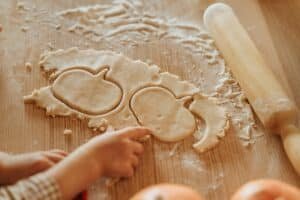 At Wishing Well, snack time and lunchtime are relational experiences rather than a functional one. Our teachers engage with children, talk, laugh, and model social skills—just like a family kitchen table.
Simple cooking activities like making fruit salad or spreading cream cheese on a bagel can empower children. We often hear phrases like this spoken with pride,
“I made this.”
“I helped.”
“I can do this myself.”
Confidence is an essential ingredient in your child’s early childhood education at Wishing Well.
The Kitchen Is More Than a Room
As we have seen, the kitchen is more than a room,
It’s a classroom, a memory-maker, a community-builder, a sensory playground, and a love language.
In both the home and at preschool, the kitchen is where children learn some of life’s most important skills: connection, confidence, communication, and care—for themselves and for others.
As you enter the hustle and bustle of the holiday season, we hope you will take the time to gather around the table regularly as a family, and to invite your preschoolers into the fun of baking and making some of your family’s holiday favorites! These small experiences will remind you that the kitchen is not just for filling tiny tummies, but for shaping your child’s heart, through memories that will last a lifetime.
Happy Holidays, from our kitchen to yours!